


 d
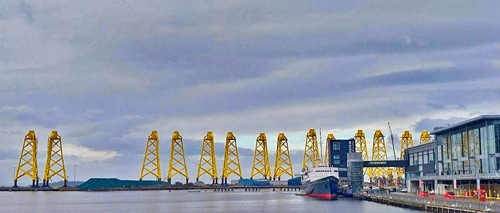
A view of monopiles for Inch Cape with the preserved Royal Yacht "Britannia".
© John Yellowlees, 2026
Explaining that Forth Ports is the UK's third largest operator with eight ports, Chris Monteith showed us how £50M private investment in the Port of Leith is delivering the 1.1-gigawatt Inch Cape Offshore Wind Farm which has created 50 new and upskilled green energy jobs.
Forth Ports in-house logistics division is handling Inch Cape's 54 monopiles and jackets at Leith, with preassembly and marshalling of the turbines at Dundee.
Once completed in 2027, Inch Cape will generate enough green energy to power half of Scotland's homes, with 274m-high turbines - 20 metres higher than Arthur's Seat. A new onshore substation is under construction at the site of the former Cockenzie Power Station.
The presentations started with Neil Gould considering the relationship between policy, the economy and investment and how they need to be balanced to grow the economy, improve resilience and protect the environment.
 d
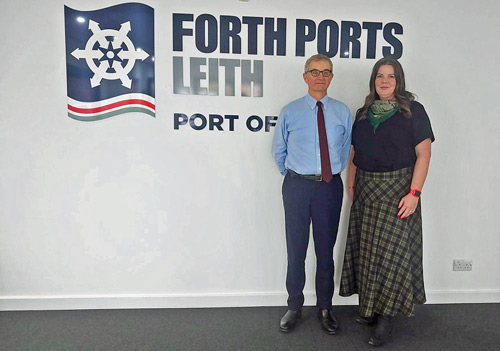
Neil Gould, Chairman of Freight and Logistics Policy Group, CILT (left) and Sara Duncan Head, of Transport and Logistics William Grant & Sons (right).
© John Yellowlees, 2026
The policy environment is subject to UK fiscal constraints e.g. the recent decisions to cut spending on roads to support defence. UK and Scottish Trade strategies were broadly aligned with food and drink promoted in Scotland.
From a Planning perspective, NPPF is welcome for the inclusion of freight and transport infrastructure. The Scottish equivalent NPF4 is more climate driven and highlights the need for coordination across the tiers of national, devolved governments and regional authorities, especially where reorganisation is proposed.
A stable framework which connects infrastructure across regions is required.The current economic outlook finds IMF more optimistic for UK in 2030, slightly higher in Scotland, however this is predicated on policies being delivered. A recent Diffley survey found that , although slightly improved, confidence remains low and current evidence not good e.g. Ineos and Syngenta. The UK trade balance shows a deficit, but Scotland's is export-driven and more balance with Food and drink including potatoes and biscuits as well as whisky. More analysis of imports and exports could provide more opportunities to refine policy and investment as subsequent discussion showed.
The investment environment comprises public funding and private investment to meet market demand. The relationship between these three elements needs to be understood and managed to improve the effectiveness of investment in delivering a financial return and achieving the goals of resilience and climate change. The latest EY European attractiveness survey indicates that perception that the UK has "strong fundamentals tempered by concerns on energy costs, policy direction and economic uncertainty". Scotland is still in the top three of UK economic regions and among the top 15 in Europe.
Sara Duncan reminded us that Scotland doesn't just make things, we move them - but the exporter's question must be whether the whole journey can compete. The export journey is a network, not a mode : infrastructure creates capability, but friction determines whether we can use it and every handover can add time, cost, uncertainty or administrative burden.
Capacity isn't capability: the former exists as a terminal, port, vehicle or route, but the exporter can use it only when frequency fits the operation, cost and service are viable, equipment and volumes align and a fallback can be activated. Rail's reliance on the West Coast Main Line can be put at risk by recurrent flooding and other disruption. Costs of terminal investment may work against alternatives to trucking, while electrification doesn't necessarily work in rural areas.
Resilience means viable choices, with options for available alternatives that have suitable capacity, processes and documentation, visibility, ownership and early warning. Who owns the whole journey, not just the asset?
The challenge is to build a network that lets Scotland compete. Where does Scotland have the infrastructure capacity that businesses cannot yet use effectively, which points of friction create the greatest cost, delay or uncertainty - and what are the additional choices that would strengthen resilience and help grow international trade? Scotland can make it, the question is whether we have built a network that lets us compete.
Report by John Yellowlees
The CILT Logo is a registered trademark of the Chartered Institute of Logistics and Transport
Unless otherwise stated, site and contents © John G. Fender 1997 - 2027. All rights reserved.
Site designed & maintained by John G. Fender, Bsc., FCILT