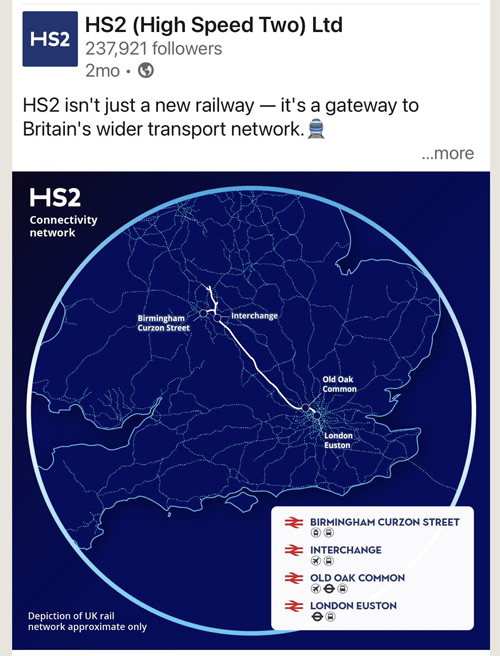
Since the Coronation Scot in the 1930s, the West Coast Main Line has connected Scotland with London in speed and style. Electrification in the early 1970's and later tilting trains have already reduced Glasgow-London journey times to a little over four hours. With work on the ground now well under way, the construction of HS2 between Lichfield and London presents the opportunity to cut times still further.
Chris Gibb's career as an operator has given him an awareness of the Scottish dimension that has been lacking from any pronouncements since 2020 by HS2. Yet Scotland's future will be bound up with the new line because trains will divert onto it, and Northern Powerhouse Rail will be no help to points further north. The timetable envisaged by HS2 has just one fast Anglo-Scottish train per hour linking Glasgow and London with stops at Carlisle, Preston and Old Oak Common.
In a move that predated PM Rishi Sunak's cancellation of the northern leg which prevents them from running in multiple north of Birmingham, HS2 has ordered 54 8-carriage trains with 504 seats. Today's 11-carriage Pendolinos have 607 seats and operate twice an hour between Glasgow or Edinburgh and Euston.
With 37% fewer seats than now , the HS2 order is insufficient to replace the 574 Pendolino carriages, and could result in compulsory reservations to choke off demand. Imagine trains being fully booked for weeks before major sporting or other events!
HS2's new trains won't tilt, which is how trains go faster north of Lancaster. Planned renewals with ETCS in-cab signalling can make even higher speeds a reality for tilting trains from 2040. But the 20 minutes gained by running via the new line would be lost by slower running without tilt further north.
The fire near Glasgow Central in March fortuitously occasioned a demonstration that Platforms 1 and 2 can accommodate trains as long as 286 metres, and the 1990s expansion of Polmadie Depot for Regional Eurostar created the capacity there. Tilt remains in vogue abroad, such as on the transalpine services linking Switzerland with Italy.
HS2 is now likely to connect with the WCML in 2040 at the same time as the Pendolinos retire. The solution is to start planning a tilting replacement, competitively tendering for 43 12-carriage trains that can reach 140 mph and run on HS2 to 186 mph.
They could operate between Scotland and Euston providing 1500 seats twice an hour, also thrice an hour between Manchester and Euston. The Glasgow-Euston journey time with an hourly fast train could be 3 hours 38 minutes, highly competitive with air and motorway and good for economic growth.
Now is the time for the UK and Scottish Governments to rekindle the ambitious spirit of the Coronation Scot and plan today for faster larger trains on the WCML when HS2 opens.
Report by John Yellowlees
The CILT Logo is a registered trademark of the Chartered Institute of Logistics and Transport
Unless otherwise stated, site and contents © John G. Fender 1997 - 2026. All rights reserved.
Site designed & maintained by John G. Fender, Bsc., FCILT