


 d
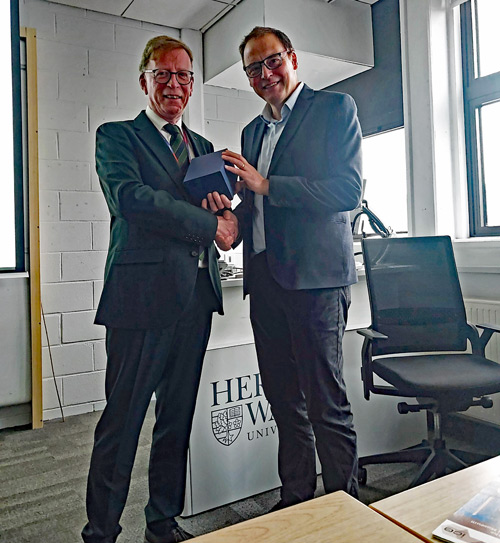
dProfessor Edward Sweeney (Left) presenting Dr. Scott Arthur (right) with an engraved glass as a memento of the event.
© John Yellowlees, 2026
As an Edinburgh City Councillor and then as chair of the Transport and Environment Committee, Scott presided over the tram extension to Newhaven, the north-south tram consultation, creation of an Accessibility Commission and the Low Emission zone and the ban on pavement parking. Local opinion favours restrictions on through traffic, but politicians have to take leaders of the local economy with them.
Recalling the heady days that surrounded his election in July 2024 as Labour MP for Edinburgh South-West, Scott told us that MPs may stand for only one Select Committee.
The parties decide between them who is to chair each committee, with Labour's Ruth Cadbury at Transport, and MPs vote for the membership in the proportion of 5 for Labour and 2 for both Conservative and Lib Dem.
Activities of the Committees may range from holding the Government to account through raising matters of public concern to self-directed inquiries. In this Parliament the Transport Committee has published four reports, into ports, taxis, skills and the Railways Bill.
Ports are a foundational part of the UK economy, keeping supply chains moving and enabling major energy projects. That's why they should be recognised as Critical National Priority Infrastructure. The National Policy Statement for Ports must also recognise that good design is about more than appearance. It should prioritise functionality, safety and minimising environmental impacts, ensuring ports can operate efficiently while meeting modern environmental standards. The Government should go further in recognising the role ports play in within the wider freight network. Planning decisions should actively support greater integration between ports, rail and other freight modes, helping to reduce emissions, encourage modal shift and support the journey to net zero. A planning framework that backs efficient, connected and resilient ports will strengthen the economy, support the energy transition and deliver a more sustainable freight system.
On the Railways Bill the Committee welcomes the ambition to increase freight and recognise the need to ensure it remains a priority as the network evolves. However the Bill could go further by providing stronger incentives to support freight growth and greater certainty for businesses looking to invest. Clearer safeguards would help ensure railfreight can expand, delivering economic and environmental benefits while reducing pressure on our roads.
Annual targets at a glance show the EV transition supercharging from just 22% of all car-sales back in 2024 through 33% this year to 52% in 2028 to 80% in 2030 and 100% in 2035. Traders who exceed their target can sell their credit. The head of Arnold Clark reports that 12% of his sales are EVs, the majority through salary-sacrifice schemes, and Government policy is helpful only in fits and starts, while no product exists for electric HGVs and there is no second-hand market for vans.
Scrutiny of the draft Heathrow expansion national policy statement has addressed Government Policy, impact on regional airports including Edinburgh, the interests of the airlines and effects on imports and exports where Heathrow handles roughly 75% of all UK air cargo by value (£127bn exports, £166bn imports). Among the airlines there is no support for the Airport's expansion plan, with preference instead for a private entrepreneur's rival scheme, but the Airport is focused on delivery and just seeks to bill them. An extraordinary dominance in the statistics is exerted by Non Metallic Gold, which represents £63bn of the exports and £117bn of the imports, and Heathrow sees only three freight flights a day. One-third of Heathrow passengers are interlining, and the Airport is a net exporter of tourist income.
Freight benefits are under-represented in Government modelling - Logistics UK has argued that the economic assessment does not adequately capture the value of air freight, particularly its contribution to trade, productivity and economic growth. Air freight is critical to UK supply chain resilience- witnesses highlighted that freight movement through airports helps businesses maintain resilient supply chains, something they believe should be given greater weight in the policy. Heathrow plays a strategic role in international trade - Logistics UK stressed that it is more than a passenger airport, but also a major gateway for imports and exports, supporting UK businesses that rely on global markets. Hub airports provide logistics advantages that point-to-point ones cannot, aggregating demand and enabling a much larger range of global connections. Most long-haul aviation depends on hubs, with 90% of long-haul flights involving a hub at one end.
Other topics have included safer journeys for women and girls, joined-up journeys, road safety strategy, HGV and driver facilities, car-clubs and car-sharing, transport and the National Infrastructure Commission, the working of shadow Great British Railways and driving test availability.
Only through two procedures may backbench MPs introduce their own legislation. The Ten-Minute Rule seldom works, but Scott came near the top of the ballot for Private Members Bills. With the support of forty charities, fortunately he was able to work round serial objector Sir Christopher Chope MP, and the Rare Cancers Act provides for review of marketing authorisations for orphan medical products, enablement of health data to support clinical trials and an expanded duty on the Secretary of State explicitly to research into rare cancers. The types within scope represent 45% of all cancers, and expansion of research could create many jobs.
On local issues, the Edinburgh South Suburban Railway does not work without the north-south tram line, in which there is still life following the recent consultation, and the question is how to provide the funding which in other countries comes from Government. The number of Scottish Councils may reduce from 32 to 6, with wards grouped into localities that report to regions, which would leave no identity for cities. Meanwhile a brochure promoting the Edinburgh Metro of the 1980s is rare evidence that the old Lothian Regional Council ever existed.
The role of an MP is all about communication, which must be two-way between Government and people. Party politics has its place, but Scott tries to be optimistic, working with like-minded people on overcoming party divisions so as to get the best result. There are issues (such as illegal bikes) that generate a groundswell of public opinion, and Westminster Hall debates often generate a more cross-party consensus than those in the main Chamber.
In addition those attending this event had the opportunity to visit the TransiT - Digital Twinning for Transport Decarbonisation lab by invitation from Professor Philip Greening, who along with Dr. Siti Fariya introduced those attending to some of their fascinating work on digital twins in transport and logistics decarbonisation. For more information on TransiT - Digital Twinning for Transport Decarbonisation, visit their website at www.transit.ac.uk
Report by John Yellowlees
The CILT Logo is a registered trademark of the Chartered Institute of Logistics and Transport
Unless otherwise stated, site and contents © John G. Fender 1997 - 2027. All rights reserved.
Site designed & maintained by John G. Fender, Bsc., FCILT