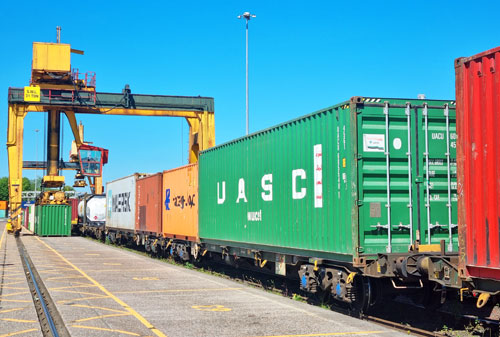
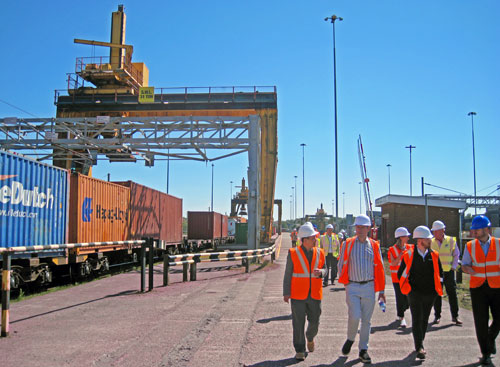
A visit on 14 May devised as part of the Railway 200 celebrations included a presentation by Martin Bignell on the role of the Rail Freight Group and a conversation between Julian Worth, CILT Railfreight Forum and Kenneth Russell our host from Russell Transport.
Established in 1969 as John G. Russell Ltd on the acquisition of Alexanders of Coatbridge, Russell Transport is today a leading player in the railfreight industry, offering intermodal rail services, container haulage and storage plus also ancillary services including tank-wash and storage. Down the years there has been a transformation not only of our industrial base from coal and steel to the service sector and retail consumption.
Due to changes in work-life balance the expectations of drivers is different, for many a week on the road is no longer acceptable. It was the more efficient use of drivers that first drew Russell to railfreight, long before public awareness began to grow of its environmental merits. One train can carry the equivalent of 30 to 50 lorry loads.
As a major centre of ironfounding, Coatbridge was from rail's earliest days at the heart of the Scottish network, and the Gartsherrie Ironworks was developed by William Baird close by the pioneering Monkland and Kirkintlloch Railway. As local supplies of ironstone and coal ran short, it became increasingly reliant on longer-distance flows, and despite rebuilding in the 1950s finally closed in 1967.
As a result of the Beeching Report, British Rail was then developing a liner-train network for intermodal traffic, and redevelopment of the Gartsherrie site enabled Coatbridge to join its network of Scottish terminals. Overhead electrification reached there 1981, but during the 1980s Freightliner's domestic flows fell victim on price to road competition, leaving Coatbridge as the sole Scottish survivor, now dependent on international business, for which it would be joined in the 1990s by Mossend in expectation of Channel Tunnel traffic.
In today's Scottish railfreight sector 83% of traffic is cross-border, 65% using containers. Russell is one of three family-owned businesses providing intermodal services, and there are six competing train operators ensuring healthy "co-opertition", with construction the main other traffic and effective alignment in place between the interests of the Scottish Government, Network Rail and the operators.
Now in the top 50 of Scottish private companies, Russell Transport rebranded Russell Railroad today has 820 employees and 250 road vehicles with £90M revenue and 1.5M square feet of warehousing, all of it in Scotland. The rail network comprises six depots and twelve third-party terminals, strategically located across Britain.
Whisky plays a massive part in Russell's operations, embracing several legs in the journey. Raw materials of wheat and barley must now travel much further than in the past, and movements of the product are for maturation, blending, bottling and to the final market. Other than Tesco to Inverness and Highland Spring from Blackford, all internal travel within Scotland is by road - a trial of whisky from Elgin a dozen years ago proved that rail would have been feasible had the parties collaborated to bring down costs - and there are two road-only depots at Aberlour and Invergordon plus the unused Norfrost site in Caithness that succumbed when Comet went bust. Bulk hauls by rail to English distribution centres like Daventry and ports (Southampton, London Gateway, Felixstowe) are made viable only with backloads often involving triangulation with other drink products on international flows so future emphasis must be on multi-customer trains, but nearly all customers now have their own carbon footprint requirement.
Warehousing is vital to cope with seasonal fluctuations in demand, and other services on offer include contract packing, labelling for different countries, bottling and self-storage. The last-mentioned can be for private individuals or say restaurants, and may be about components or parcels. Engineering activities born out of Russell's experience with their own fleet can embrace maintenance of road vehicles, removal of discolouration caused by bacteria attacked by whisky, repurposing and refitting of assets. The subsidiary Carntyne Transport acquired in 1971 which original dealt with bulk transport of slag in tippers has been repurposed to specialise in the handling and storage of whisky casks.
After the Coatbridge site had been left to its own devices for many years during which external pressures prompted diversification into domestic intermodal, its acquisition by Russell from Freightliner in 2024 prompted inevitable concerns about buying into rail infrastructure, but the people issues seem to have signified a willingness by staff to join the new owner on a journey of discovery. This has already seen a growth in throughput, from three to eight services daily, with two more services daily in prospect. Opportunities include a second Blackford train, a new flow from West Fraser at Dalcross, as well as for a resumption of distribution to Aberdeen. Investment has already taken place in improved hardstanding for reachstackers, and will be required in the cranes, which are sixty years old and limited in their versatility and capacity.
The high price of electricity charged by Network Rail has seen some substitution of diesel traction for electric, but Freightliner Class 90s remain on double headed haulage of their trains, and even a diesel Class 66 is much more environmentally-friendly than road haulage. The target of attaining Net Zero by 2040 gives only a short window of opportunity to deliver a network with sufficient capacity and capability - achieving Blackford took longer than we now have - and there are concerns about Electric Road Vehicle capability given the length and character of Scottish internal journeys and the impact of the Scottish winter on battery range. It remains to be seen whether hydrogen fuel cells could expand battery-power's range at the margins. Russell is planning to be part of wider trials on alternative fuel traction including hydrogen trucks. At present the only commitment is to trial these options, and it is too early to commit to any transition.
A walking tour of the site after lunch enabled us to see the cranes in action and to note an operational advantage that trains can enter from either end with electric traction. CILT are most grateful to Russell Transport for providing an event that by demonstrating recent success and outlining a positive future for railfreight, offered a sense of celebration most worthy of Railway 200.
Report by John Yellowlees.
The CILT Logo is a registered trademark of the Chartered Institute of Logistics and Transport
Unless otherwise stated, site and contents © John G. Fender 1997 - 2026. All rights reserved.
Site designed & maintained by John G. Fender, Bsc., FCILT